


Evangelizing in Space: The Superpowers a Change Agent Needs to Move Worlds
- Malcolm De Leo

- Oct 7, 2025
- 26 min read

Being an evangelist is not for the faint of heart. Honestly, some days it feels like walking barefoot across hot coals—necessary if you want to get to the other side, but painful as hell along the way. Why? Because by definition, you’re the one disrupting the current. You’re the swimmer going upstream while everyone else drifts downstream with the current. You’re the person who sees something that doesn’t yet exist, then has to convince others—often skeptical, distracted, or flat-out resistant—that it’s worth moving toward. It’s lonely work. Frustrating work. And yes, occasionally brutal.
And yet, here’s the paradox: this is exactly why it matters. Real change doesn’t come from comfort zones; it comes from friction. The job of an evangelist, or any change agent, is to turn that friction into momentum—to transform resistance into curiosity, and curiosity into commitment. That’s no small task.
So how do you actually teach someone to do this work? Plenty of people will tell you that you can’t—that it’s some mysterious gift you either have or don’t. I don’t buy that for a second. After years of carrying this particular banner, I’ve learned the hard way that survival (and success) depends on three things: having the evangelist's heart (something that's hard to teach), the inner muscles you build, and the external tools you wield.
Our heart has to carry a special ingredient: volition. Without it, the power to take that first step toward change simply isn’t there. Your heart has to beat with the will to move—toward the change, into the danger, through the uncertainty, and ultimately toward the glory of bringing a vision for the future to life. Volition is that inner spark that turns intention into action, the pulse that keeps the evangelist walking forward when others hesitate at the edge of just standing there watching.
The inner muscles—creative inquiry, the ability to ask challenging questions in a way that sparks new insights and pulls others into the conversation; collaborative learning, the humility to learn from others and honor their perspectives so you don’t get trapped in your own paradigm; perseverance, the stubborn ability to keep moving forward when obstacles pile up; synthesis, the knack for seeing the whole picture before the solution is fully formed; and enlightened dissatisfaction, the belief that “better” is always possible and perfection is a process, not a destination. These are the muscles that let you keep showing up when the room turns cold.
But inner strength only gets you so far. We also need to talk about external tools, too: the practical skills you reach for in the moment, in the room, with the people you’re trying to move. Skills like facilitation—the ability to drive the conversation where you want to when it wants to stall or they just can't see where to go. Negotiation—knowing when to bend, when to hold firm, and how to get to yes without leaving bodies on the floor. Operational definitions—agreeing on what words and goals actually mean so you’re not arguing over ghosts. And expectation management—setting the guardrails so you don’t crash into disappointment later. These aren’t abstract ideas; they’re the everyday tools that give shape to the vision and make it possible to carry others with you.
Over time, I’ve come to treat these tools the way a climber trusts their gear. They don’t guarantee the summit, but without them, you don’t stand a chance. They allow me to “innovate in space”—by that I mean no matter the project, the politics, or the players involved, I can read the dynamics, adjust, and still find a way to move people closer to seeing the value of the change. That’s the art form hidden inside the grind. If you can master when and how to use these tools, you’ll be surprised at how often you can make change happen—even in the most unlikely of places.
First, let's discuss Evangelism and its definition
Why bother defining evangelism?
If I had a dollar for every time someone asked me what I actually do, I wouldn’t need to keep doing it. It’s maddening to have a role you fully understand, but everyone else stares at like it’s written in hieroglyphics. Over the years I’ve even learned to break the tension by telling people they’re allowed to laugh at the title I have held several times across my career—Chief Evangelist—because I can literally see their brains glitch when they try to wrap their heads around it.
So let’s just name it and define it. And like all big concepts, the definition has to be wide enough to include as many people as possible. I call it organizational evangelism—and there’s a reason for that.
Why does that term matter? Because if you strip away the purist, biblical definition—“the spreading of the Christian gospel by public preaching or personal witness” (thanks, Google)—you’re left with the essence of evangelism: spreading belief in an idea. And that applies to far more people than those who happen to have “evangelist” on their business card.
The word organizational is key here. It signals that the person doing the evangelizing is part of a group, or trying to create one, or sees one that desperately needs direction. It also makes the idea bigger than Corporate America, which is where the role traditionally gets stuck. Organizational evangelism opens the tent wide—it allows anyone working on any cause, company, or community to step inside.
And maybe the most important part: it helps people recognize something they might already be doing without realizing it. Because if you’ve ever seen a better future, shared that vision, and tried to rally people toward it—you’re already practicing organizational evangelism.
So, what is the actual definition of Organizational Evangelism?
Here it is, plain and simple:
A person who can see what is possible, craft a message that brings it to life, and has the ability to lead others there without having defined control of the vision they have conceived.
That’s the whole game. But like most things that look deceptively simple, there’s more going on beneath the surface. Let’s pull it apart, phrase by phrase, and see what it really means.
Can see what is possible: This is the spark. The starting point of any kind of evangelism is vision—the ability to see something others can’t quite picture yet. Call it foresight, intuition, or just stubborn optimism, but it begins with glimpsing a future that isn’t fully formed and believing it’s worth chasing.
Craft a message that brings it to life: Seeing the distant horizon is one thing. Bringing it back to the present in a way people can actually understand? That’s the hard part. It means taking the big, abstract vision and breaking it into digestible pieces—clear milestones, tangible wins, little proofs that turn belief into reality. Without that translation, your vision stays a daydream.
Ability to lead others: You can shout from the rooftops all you want, but if no one is willing to walk alongside you, you’re not evangelizing—you’re just shouting. Real evangelism is about influence without coercion. It’s about pulling people into the journey, not pushing them down the path.
Without having defined control of the vision: This, to me, is the most important part. True evangelists don’t need a title, a budget, or a team to move people. Authority makes things easier, sure, but it isn’t the essence of the role. Evangelism is about leading without formal control—painting the picture so vividly that others choose to come with you. That’s where the magic happens.
So there you have it: a high-level definition of organizational evangelism. It’s not just a concept to nod along with—it’s a filter. You can use it to check yourself, to think about who you are, the role you want to play, and the change you’re trying to spark. With this foundation, you’re not just carrying a vision—you’re learning how to make others believe in it, too.
Now let's dig into the heart, muscles, and skills, their definitions and why they are important
The Evangelist's Heart
There is one element critical to power the Evangelist: Volition.
My work dad, Robert Rosenfeld, shared this idea with me. And if you think about it a bit, it makes sense that an inner core of Volition is critical.
What is Volition?
Volition—sometimes called will or conation—is the cognitive process of deciding and then committing to a course of action. Psychologists call it purposive striving, but in plain English, it’s the part of us that chooses and then pushes forward. It’s one of the core engines of human behavior.
Think of it as the inner drive that gets you to take that first step toward change. For an Evangelist, though, volition isn’t just about motion—it’s about courage. It’s the willingness to walk straight into the storm, knowing full well the forces you’re confronting will resist, hold you back, or even try to kill off your attempts at progress. To choose this path is to choose conflict, and the Evangelist doesn’t shy away from it.
That’s why volition isn’t optional. It’s the heartbeat of the role, the core competency beneath the supersuit. Without it, you’re just standing on the sidelines watching the current flow by. With it, you’ve got the fuel to step into the arena and keep moving, no matter what’s thrown your way. The Internal Muscles: Finding inner power
Below is a summary of what I’ve come to believe are the internal innovation muscles every evangelist must develop to create a foundation for real change. These ideas were built in collaboration with my good friend Robert Porter Lynch, who first shared them with me during our work together. Over time, we both came to see these as the inner core of what I call “innovating in space.”
Why call them internal muscles? Because if volition is the evangelist’s heart, then these are the muscles that absorb the world around you—the experiences, the feedback, the resistance—and convert it into the fuel you need to bring that true north vision to life.
They’re what keep you upright when the wind of opposition hits full force.
Only when these muscles are strong can you push through the wall of resistance every change agent eventually faces. They’re what let you keep climbing when others stop, what transform fatigue into endurance, and what turn belief into movement.
So, let’s dig in. Here’s what these internal muscles are, why they matter, and how they serve as the deep fuel source for every Evangelist ready to take on the hard work of leading change. Below is a summary of the internal innovation skills
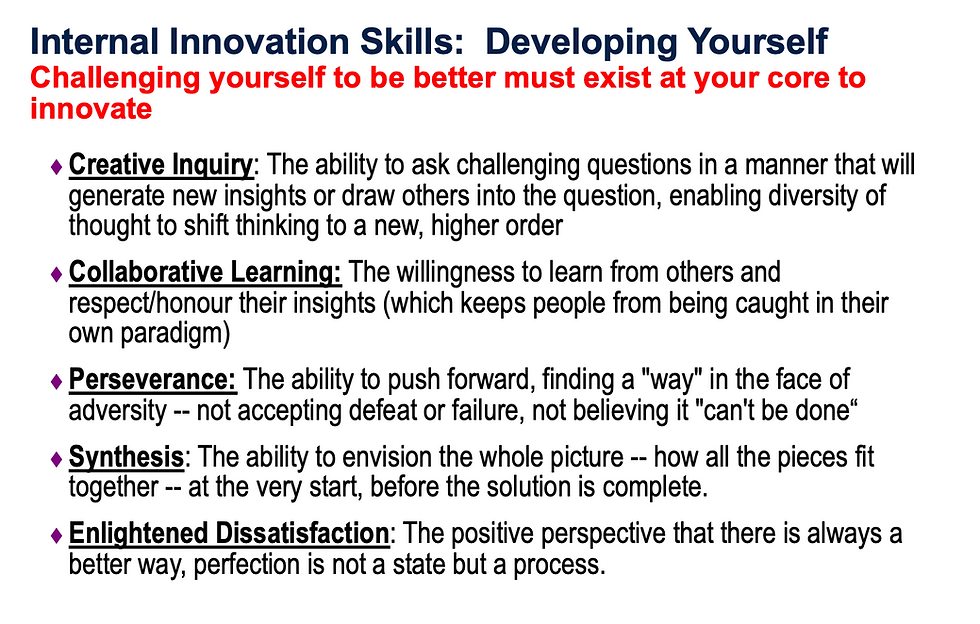
Creative Inquiry: The Magnet of the Evangelist
What is it?
Creative Inquiry is the ability to ask questions that challenge, provoke, and ultimately expand how people think. It’s about creating new insights that pull in diverse perspectives and elevate the conversation to a higher level of thinking and collaboration.
Why is it important?
A great evangelist doesn’t dictate—they attract. The real art of evangelism is gravitational: you draw others toward your vision, not by pushing your ideas, but by inviting theirs in. Creative inquiry is how you do that. It’s the skill of asking questions that open doors instead of closing them, that reveal how others see the world so their thinking can be woven into your true north vision. When you understand others deeply enough to include their ideas in your story, your vision becomes our vision—and that’s when momentum starts to build.
Why is it fuel?
Diversity of thought is oxygen for innovation. When you invite multiple ways of seeing, you build the kind of inclusive, expansive thinking that makes big ideas possible. Without that openness, an evangelist risks becoming a dictator of ideas instead of a magnet for them. Creative inquiry keeps your perspective wide, your ego in check, and your leadership strong enough to pull people in rather than push them away.
Collaborative Learning: Egoless Listening
What is it?
At its core, collaborative learning is simple: it’s the willingness to learn from others. It’s recognizing where your gaps are, understanding that you don’t have all the answers, and being open enough to take what others know and use it to make yourself—and the vision—stronger.
Why is it important?
If your ego’s too loud, no one of value will follow you. The truth is, people rally behind leaders who listen. When you believe that the best idea wins, you create space for better thinking to emerge. The world is full of learning sponges—people constantly evolving, adapting, and changing—and the best evangelists are no different. They absorb what’s around them, synthesize it, and use that collective wisdom to navigate toward true north. Those who keep learning are the ones best equipped to guide others, because they can see the landscape from more than one angle.
Why is it fuel?
Collaborative learning is the evangelist’s bond with others—the connective tissue of trust. When you’re willing to be a student of the people you hope to lead, you create an environment where learning flows both ways. That exchange builds trust, deepens loyalty, and amplifies momentum. When you open yourself to others, they open themselves to you—and that’s when the real movement begins.
Perseverance: The Volition Muscle
What is it?
Evangelists live in the land of “no.” It’s part of the job description. Driving change isn’t for the faint of heart—it takes persistence, resilience, and a stubbornly optimistic belief that the next door might open if you just keep knocking. Perseverance isn’t simple hard-headedness; it’s more creative than that. It’s the art of pushing forward when logic says stop, finding light when the tunnel feels endless, and inventing new ways to stay motivated when every sign points to turning back.
Why is it important?
Change is hard business. Most people don’t even try because they’ve already convinced themselves it won’t matter. But an evangelist doesn’t have that luxury. “Why bother” isn’t in your vocabulary. Without perseverance, you might as well stay in bed or drift through the day punching the clock, half-asleep in the matrix, never discovering what’s possible on the other side of resistance. The ones who change the game are the ones who keep showing up— bruised, maybe, but still moving.
Why is it fuel?
Because perseverance is the energy source that keeps the engine running when everything else breaks down. It’s the ability to treat failure as feedback—to see every setback as data pointing you toward what will eventually work. Perseverance is how you turn frustration into momentum, doubt into focus, and fatigue into discipline. It’s not just endurance—it’s propulsion.
Synthesis: The Eye of the Evangelist
What is it?
Synthesis is the ability to step back, take everything you’ve learned—from others, from the market, from your own vision—and mix it into a coherent whole. It’s how scattered insights become a single direction. Think of it as baking the future cake—the process of turning raw ingredients into something real, something others can taste and believe in. Synthesis is what transforms your “true north” from a vague idea into a destination others can start walking toward, even if they can’t yet see the full map you do.
Why is it important?
Synthesis is the muscle that makes your volition worth acting on. It’s the internal loom that weaves what you see, hear, and feel into a clear tapestry of purpose. Without it, your big vision stays abstract—just a pile of disconnected patches on the floor. But when you can stitch those fragments together into a picture that others can recognize, you give them something to follow, something beautiful enough to believe in.
Why is it fuel?
Because synthesis is what gives vision form. Without it, there’s nothing to lead others toward—just noise and good intentions. Synthesis turns insight into clarity, clarity into action, and action into momentum. It’s the muscle that keeps the dream grounded in reality while still pointing to the stars.ers towards. If you can bring the vision into focus, you have nothing.
Enlightened Dissatisfaction: Relentless Belief
What is it?
Enlightened dissatisfaction is the evangelist’s belief that there is always a better way. Change is never static—it’s a living, breathing force that demands motion. A true evangelist is never content with “good enough.” They’re constantly searching for better ways to make better things even better. It’s not change for the sake of change—it’s purposeful evolution. It’s the understanding that even when you finally reach your “true north,” the world keeps shifting. So, you must be ready to reassess, realign, and set your compass toward the next horizon.
Why is it important?
Evangelists are wired to move—always learning, always exploring, always stretching toward what could be. Enlightened dissatisfaction keeps them from becoming complacent. It’s what transforms arrival into renewal. Every journey toward a vision teaches new lessons, and the best evangelists carry those lessons forward—refining their craft, deepening their understanding, and helping others grow alongside them. The work is never done, and that’s exactly the point.
Why is it the fuel?
Enlightened dissatisfaction is the current that runs through all the internal muscles. It gives purpose to creative inquiry, pushing you to keep asking better questions. It strengthens collaborative learning, reminding you there’s always more to learn from those around you. It powers perseverance, driving you to push forward when others would settle. And it focuses synthesis, urging you to refine and rebuild your vision again and again as the world evolves.
It’s the cyclical fuel that keeps the evangelist in motion—the restless, hopeful belief that the next version can always be better. It’s what turns curiosity into growth, resistance into progress, and change itself into a lifelong calling.
The External Skills: Turning Inner Strength into Outward Motion
If the internal muscles are what give an evangelist strength from the inside out, then the external skills are how that strength shows up in the world. They’re the tangible behaviors—the visible actions—that turn conviction into motion and transform vision into progress.
This is where belief becomes behavior. Where that inner drive, discipline, and creative fire get translated into something others can actually see, feel, and follow. Because an evangelist isn’t just someone who dreams big—they’re someone who moves big.
These external skills are the tools you reach for when it’s time to take what’s been forged inside—your curiosity, perseverance, synthesis, and relentless belief—and drive it into action. They’re how you navigate real rooms, real people, and real resistance. The muscles power the movement, but these skills give it direction, form, and impact.

Unlike the internal muscles—which each fire independently like five distinct engines—the external skills come in two powerful classes: Communication Clarity Skills and Collaborative Influencing Skills. Together, they’re the levers that turn intent into impact.
Let’s dig into each and how they come to life in the practice of evangelism.
Communication Clarity Skills
Evangelism lives and dies on clarity. If you can’t get people on the same page, your message starts to blur—and once credibility slips, good luck getting it back. Clarity isn’t about being clever or polished; it’s about being uncomfortably precise. It’s how you make sure the signal cuts through the noise.
These skills are about guiding people along the journey, not dragging them. They’re how you build trust, set the tone for collaboration, and define the unspoken contract between you and those you lead. As an evangelist, you’re the shepherd of change—and every word, gesture, and definition you use is part of that guidance system. When clarity falters, confusion fills the void. But when you’re clear, even complex ideas feel simple—and that’s when people start to follow.
Collaborative Influencing Skills
Here’s the hard truth: evangelists rarely have authority. No org chart will save you. No one reports to you. You don’t control the budget or the final call. And yet—you’re expected to lead.
That’s why the best evangelists become masters of influence. They move people not through power, but through connection. Their tools are wit, empathy, and timing. If you can convince others to follow you without hierarchy, you can move mountains—or at least get the mountain to start walking with you.
Think of it like being Neo in The Matrix—seeing the system before everyone else does, anticipating the bullets of resistance, and gracefully stepping out of their path before anyone gets hit. These skills aren’t about manipulation; they’re about navigation. They’re how you make progress feel like your partner’s idea, aligning their goals with your vision so everyone feels ownership of the change.
Communication Clarity Skill 1: Operational Definition Creation
What is it?
The ability to ensure that everyone is defining things the same way.
When did I learn it and realize it was a critical skill?
I’ll never forget my MBA operations professor. Ironically, he barely taught operations. Instead, he obsessed over one idea: operational definitions. His favorite question was deceptively simple—when two people point at something and call it “pink,” are they picturing the same shade? If not, you’re already in trouble.
The more I thought about that class, the more profound it became. Once I started paying attention, I noticed how often people in meetings would nod in agreement, smile, and move on—only to walk away holding completely different interpretations of what had just been decided. And sure enough, when things went sideways later, I could almost always trace it back to that moment of unspoken misalignment.
Why is this so critical to learn?
Here’s a simple illustration. Imagine two engineers collaborating on a new piece of equipment—one from England, one from the United States. The British engineer owns Part A, the American owns Part B. They meet to ensure everything aligns. Now imagine, as they discuss measurements, one is thinking in centimeters and the other in inches, but they never clarify the units. Each builds their part to spec—by their own definition—and when it’s time to assemble, nothing fits.
It sounds obvious, almost laughable. But that’s the point. Misalignment hides in plain sight. If you’re not actively listening for incongruence—those subtle “wait, what did they mean by that?” moments—you’ll end up with two perfectly built parts that don’t connect. Everyone must agree on the operational definition of what’s being discussed. It’s a simple thing, but it’s everything.
I’ve learned this lesson the hard way. Misaligned definitions have cost me time, trust, and more than a few gray hairs. But catching them early—pausing to make sure everyone’s actually talking about the same thing—has saved more meetings than I can count. People will often thank you just for clarifying the obvious. Because when you clear the fog, progress suddenly comes into focus—and that’s when real movement begins.
Why is it important?
There are two big reasons this skill matters. First, it eliminates misinterpretation before it has a chance to take root. Second, it creates shared definitions that make collaboration smoother and faster. When everyone is working from the same playbook, you stop tripping over words and start making progress.
Operational definitions are the bridge between understanding and action. And they connect directly to the next external skill—Expectation Management—because even the clearest definition won’t save you if everyone’s marching toward a different destination.
Communication Clarity Skill 2: Expectation Management
What is it?
The ability to be clear on what you can or cannot accomplish
When did I learn it and realize it was a critical skill?
Almost everyone hates giving bad news. It’s human nature to want to please, to avoid disappointment, to keep hope alive. But that instinct can backfire fast.
I learned this the hard way in my first job managing alliances. I was overseeing a complex project to find a thickening agent for a toilet bowl cleaner—a surprisingly tough chemical challenge. Our approach at the time was to collaborate closely with suppliers, letting them propose and test solutions. After months of work, one key supplier clearly wasn’t getting there. We both knew it, but when I told them their progress wasn’t solving the problem, they insisted they still had a path. I didn’t want to disappoint them, so I let them keep going.
After the meeting, my boss—one of those mentors whose lessons stick forever—pulled me aside. “You just did them a disservice,” he said. I was confused. “Why? I was trying to be kind.” He explained: “Every day they keep working on a project they can’t win, we’re burning their resources. The minute you knew it wasn’t going to work, you started wasting their time. The right thing—the partner thing—was to tell them the truth.”
That was the day I learned that being brave enough to be clear is an act of respect, not cruelty. If I had told them directly they were being deselected, they could have redirected their energy elsewhere. They might’ve been disappointed, sure—but they would have trusted me more next time. Because managing expectations clearly gives others a choice, and with choice comes trust.
That lesson stuck. These days, managing expectations is one of the sharpest tools in my evangelist toolbox. Do I still occasionally dance around it? Sure. But I know now that clarity—especially when it’s uncomfortable—is a cornerstone of leading change.
Why is it critical to learn?
Without clarity, you can’t be a good partner. If you don’t set boundaries around what’s possible, you can’t hold others accountable when things go sideways. Managing expectations early and often builds the foundation for every other collaborative skill—especially negotiation. It strengthens trust, deepens respect, and hardens your resolve. It also teaches you to embrace one of the hardest lessons in leadership: learning to love the word no. When you master that, you stop fearing failure and start managing reality.
Why is it important?
Expectation management gives the evangelist two invaluable assets: personal integrity and long-term credibility. People trust leaders who do what they say and say what they mean. And since most evangelists operate without formal authority—no team, no budget, no command—your integrity is your currency.
When you’re clear and consistent, your network takes note. People remember how you treat them when the news isn’t good. Over time, that honesty builds a reputation that pays forward. Because in the end, the network always provides—and those who master expectation management will never walk alone on their change journey.
Collaborative Influencing Skill 1: Negotiation
What is it?
The ability to understand others' interests and create acceptable options that allow you to move forward together.
When did I learn it and realize it was a critical skill?
This one’s a no-brainer. Negotiation is the most obvious and most constant skill in the evangelist’s toolkit. If you want to drive change, you’ll be negotiating every single day of your professional life—sometimes every hour. So get used to it.
I learned negotiation formally through rigorous alliance management training early in my career. Sure, some people have natural instincts for it, but when you understand the process—when you learn to navigate the psychology, the structure, and the strategy—it’s a whole different game. Negotiation isn’t improv; it’s choreography. The better you know the steps, the more gracefully you can lead.
Why is it critical to learn?
At its core, everything we do as evangelists is a negotiation. Every conversation, every project, every request for change is an exchange of perspectives, power, and possibility. Whether it’s a customer, a colleague, or your five-year-old who refuses to brush their teeth—it’s all negotiation.
Driving change raises the stakes because you’re asking people to believe in something new, often something uncomfortable. That’s why I lean heavily on the principled negotiation framework by Fisher and Ury. It’s practical, tested, and timeless:
Focus on people, not positions. You’re negotiating with human beings—never forget that.
Probe for interests. What do they care about? What do you care about? That’s where real movement happens.
Create options. Find solutions that serve both sides, not just your agenda.
Use standards of legitimacy. Ground your asks in real examples, not just emotion.
Know your BATNA. Always have a Best Alternative To a Negotiated Agreement. Without one, you’re negotiating blind.
Here’s a simple way to think about negotiation as a tool for driving change. It’s not just about deal terms or getting to “yes.” It’s about how you relate, how you listen, and how you move the relationship forward beyond the transaction. When you focus on people first—communication, trust, shared interests—you create agreements that actually stick and stand the test of time.

You don’t need to memorize every rule, but you do need to learn the craft. Don’t wing it. Get trained. The best negotiators aren’t lucky—they’re prepared.
Why is it important?
There are two big reasons to become a great negotiator. First, negotiation makes you an expert listener. When you follow a process, you learn to hear what others value—not just what they say. And when people feel heard, they start to trust you. That trust opens the door for creative problem-solving and gives you the leverage to propose ideas that align with their interests as much as yours.
Second, negotiation is where all your other communication clarity skills come to life. Strong operational definitions keep the conversation grounded. Managing expectations builds trust. Together, they form the foundation for lasting partnerships—the very thing every evangelist depends on to move toward true north.
Because here’s the truth: no evangelist ever reaches that horizon alone. Great negotiators don’t conquer; they collaborate. They build bridges strong enough to carry everyone across.
Facilitation
What is it?
The ability to enable other to understand concepts and agree on an approach that everyone can take together.
Why is it important?
I moved this section into the second position for a reason. The other three skills—operational definitions, managing expectations, and negotiating—are essential tools in any evangelist’s kit. Operational definitions are what keep two people (or two teams) speaking the same language. It’s the discipline of listening hard enough to make sure meaning doesn’t get lost in translation. Managing expectations is where trust lives; it’s the quiet contract between what you say and what you deliver. And negotiation? That’s the muscle that moves people toward common ground. It’s how you turn competing visions into aligned momentum.
But facilitation sits on top of them all. It’s the synthesis skill—the one that weaves everything else together. Great evangelists aren’t just good facilitators; they’re invisible navigators. They know how to walk a group toward true north without ever making it feel forced. Facilitation is how you make your vision feel like everyone’s idea. And to even begin learning “innovation facilitation,” you have to master those other three first—because they’re the raw ingredients for what comes next.
Most people think facilitation means staying neutral—running the meeting, keeping time, managing the agenda, and herding a few intellectual cats along the way. But evangelist facilitation? That’s a whole different animal. You do have a destination in mind. You do have an opinion. The trick is—you can’t drag people there. You have to make them want to walk there on their own.
Evangelist facilitation lives in that delicate middle ground between influence and invitation. It’s less about controlling the discussion and more about quietly steering it. You’re part conductor, part magician, part mountain guide. You see the peak before everyone else, but you know if you point straight to it, half the group will dig in their heels. So instead, you start small. You ask questions. You float an idea. You toss out something framed as “probably stupid,” just to see how the room reacts. Then, gently, you start reframing and redirecting until the group begins to build the very idea you were guiding them toward all along.
Done right, it feels organic. Everyone in the room believes they got there. You’ve orchestrated alignment without ever showing your hand.
That’s the secret sauce of facilitation as an evangelist—it’s active, not passive. It’s steering without driving. It’s what happens when curiosity becomes your superpower. Because curiosity disarms people. It opens them up. It lets them think freely without feeling cornered by your agenda. When they feel ownership of the destination, the work of getting there becomes lighter, faster, and more collective.
And here’s where all your other skills show up to support you. Negotiation helps you balance competing interests as the discussion unfolds. Operational definitions keep everyone speaking the same language. Expectation management keeps the energy honest and the promises realistic. These are the tools that let you quietly shape the current rather than fight it.
I sometimes think of evangelist facilitation like being the river guide on a whitewater trip. You can’t stop the water, and you can’t muscle the raft—it’s too powerful for that. What you can do is read the current, sense the obstacles ahead, and use subtle shifts of the paddle to move the group safely through the chaos. By the end, everyone feels like they own the accomplishment of finishing a course they didn't think was possible.. But you know what really happened: you just kept them from hitting the rocks.
That’s facilitation at its best. It’s invisible leadership. It’s strategic humility. It’s the quiet art of helping people find their way to true north—without ever making them feel like you dragged them there.
When did I learn it and realize it was a critical skill?
Every other skill I’ve learned came from someone else.
Operational definitions? From Art Close, my operations professor.
Expectation management? From Michael Ott, my boss at Clorox.
Negotiation? From the Vantage Partners team—and yes, Michael Ott again.
But innovation facilitation? That one I learned on my own.
My first real experience as an evangelist came in the early 2000s while working in Clorox’s technology brokerage group. Our mission was simple on paper but radical in practice: help the supply chain measure innovation from suppliers—not just cost or service, but innovation itself. Most companies back then measured suppliers on price and delivery. Michael had a different idea: what if we rewarded suppliers for how innovative they were?
We called it win balancing—the notion that true partnership meant trading wins over time, not hoarding them. Suppliers that delivered innovation earned more business. Those who didn’t, didn’t. It was elegant, fair, and surprisingly effective. Twenty-five years later, it remains one of the most successful innovation initiatives I’ve ever been part of.
But here’s the connection: in this job, we had no authority. No budget. No direct reports. No power to enforce change. We were facilitators—middle-ground brokers connecting our internal teams with external partners. Our success depended entirely on our ability to influence without control.
Picture it: your performance is measured by whether a supplier solves a company problem—but you don’t make the decisions, you just manage the process. You’re threading the needle between two companies, two sets of incentives, two cultures, and a dozen hidden landmines. That was the crucible where my facilitation muscles were forged.
Over time, I started to realize something important: my power didn’t come from the org chart. It came from trust. My suppliers trusted me enough to let me guide where their resources went. That trust created leverage. It gave me “borrowed power” to move projects forward.
And internally, the dynamic flipped. Colleagues knew I had access to those supplier resources—so they wanted to work with me. Suddenly, the guy with no authority had influence. Why? Because facilitation created value where no formal power existed.
From there, the real art began. Every project meant putting two groups together—each with its own politics, pressure, and pride—and aligning them around a shared goal. It wasn’t about timelines or tasks. It was about vision, trust, and constant recalibration. Sometimes it meant applying pressure. Sometimes it meant crafting a story that bridged cultural divides. Most days, it meant balancing invisible interests on both sides to move things quietly forward.
That job was my innovation dojo. It taught me how to move people when you can’t push them, how to shape outcomes without taking credit, and how to find purpose in the invisible work of alignment. The glory wasn’t in the spotlight—it was in seeing the vision finally come to life.
Why is it critical to learn, and what’s critical to learn?
Facilitation is the ultimate evangelist skill because it sits at the intersection of every other one. It’s negotiation in motion, communication in context, leadership without authority. But it’s also the hardest to master—because it requires you to be humble enough to disappear into the process.
Here are a few truths I’ve learned about what really matters:
Thing 1: Act like you have no power—even when you do.The best evangelists move as if they have no budget, no people, and no authority. It sharpens your instincts. You stop relying on hierarchy and start relying on influence. Think of it like the Force—feel the flow of what’s possible, not what’s prescribed. When you focus on guiding the group toward true north, ego falls away and clarity takes over.
Thing 2: Throw out dumb ideas—on purpose.If you’re afraid to look stupid, don’t be a facilitator. The best way to move a group forward is to test boundaries, lob half-baked ideas, and watch what sticks. Every reaction reveals where people stand. Sometimes they’ll reject an idea outright—but that resistance gives you direction. Facilitation isn’t about being the smartest person in the room. It’s about helping the room get smarter together.
Thing 3: The movie Inception was dead on.Facilitation is the art of planting ideas. Not forcing them—planting them. Every conversation, every meeting, every casual hallway chat is a chance to drop a seed of possibility. You never know which one will take root. Keep repeating and reframing your true north vision in small ways, testing how people respond. Watch what lands, what stews, and what blooms. That’s innovation facilitation in action.
Thing 4: It’s iterative—always.Facilitation is never a single meeting or moment. It’s an ongoing loop of trial, error, and adaptation. You’re constantly learning how to get better at moving people, refining your process as you go. It’s not about perfection; it’s about progress.
Thing 5: Be a lifelong student of the evangelist craft.Facilitation requires patience, commitment, and a deep willingness to let go of control. Sometimes you grab the reins; other times you’re just the current beneath the raft. The more you see yourself as a vessel for change—not the source of it—the more powerful you become.
Evangelism, at its core, lives outside the self. That’s why facilitation is the ultimate expression of the external toolbox—it’s how the evangelist channels all their internal muscles into movement. The art of helping others find their way to true north—without ever making them feel dragged there—isn’t just a skill. It’s the heartbeat of change itself.
Conclusion: The Long Road to “True North”
I know—that was a lot to process. But then again, this isn’t the kind of thing you figure out overnight. This post reflects nearly thirty years of trial, error, and a fair amount of scar tissue. Sure, I recognized these skills as the core of evangelism a long time ago—some of the original slides I built on this topic are pushing fifteen years old—but understanding them deeply enough to explain them? That took time in the work lab.
Since those early days, I’ve lived these skills across just about every landscape you can imagine: inside large companies fighting to stay innovative, inside startups pushing technology uphill into those same corporations, and now, as a founder steering my own ship. Each vantage point tested these tools in new ways. I’ve applied them from the bottom rung of the ladder, from the middle where influence feels murky, and from the top where leadership can feel just as isolating. I’ve been the guy with no budget, no people, and no authority trying to spark change from within—and I’ve been the flea buzzing around the elephant, trying to get a behemoth’s attention long enough to adopt a new idea.
And through all of it, these skills have held true. Every. Single. Time.
That’s the real test of an idea—its universality. It has to work no matter your title, your resources, or your environment. And these do. They are, quite simply, the essential skill set for anyone who wants to make change happen anywhere.
Too often, I’ve met brilliant people too afraid to rock the boat. They’ll whisper great ideas in hallways but never bring them to the table. I tell them what I’ve learned: you don’t have to smash the boat to make waves. With these skills, you can drive change without chaos—you can guide it. The process might be uncomfortable, but it doesn’t have to be reckless.
My work dad, Bob Rosenfeld, used to remind me: “Companies don’t innovate—people do.” And he was right. A company is nothing more than a collection of people, each bringing their own ideas, fears, and ambitions to a shared culture. If the people stop innovating, the company stops breathing.
So here’s my challenge to you: think bigger. Build these muscles. Master these tools. Learn how to make yourself heard—not for the sake of noise, but to help others see what you see. Because when you do, you won’t just move projects forward—you’ll move people. And when you move people, you move the world a little closer to that true north we’re all searching for.


Comments